

How Is Muscle Arranged For Fast Animals
How practice muscles contract? What molecules are necessary for a tissue to alter its shape?
Muscle is a specialized contractile tissue that is a distinguishing characteristic of animals. Changes in muscle length support an exquisite assortment of animal movements, from the dexterity of octopus tentacles and peristaltic waves of Aplysia feet to the precise coordination of linebackers and ballerinas. What molecular mechanisms give rise to musculus wrinkle? The process of contraction has several key steps, which have been conserved during evolution across the bulk of animals
What Is a Sarcomere?
When muscle cells are viewed nether the microscope, one tin can see that they contain a striped pattern (striations). This blueprint is formed by a series of basic units called sarcomeres that are arranged in a stacked pattern throughout muscle tissue (Figure 1). In that location can be thousands of sarcomeres within a unmarried muscle cell. Sarcomeres are highly stereotyped and are repeated throughout muscle cells, and the proteins within them can change in length, which causes the overall length of a muscle to alter. An private sarcomere contains many parallel actin (sparse) and myosin (thick) filaments. The interaction of myosin and actin proteins is at the cadre of our current understanding of sarcomere shortening. How does this shortening happen? It has something to do with a sliding interaction between actin and myosin.
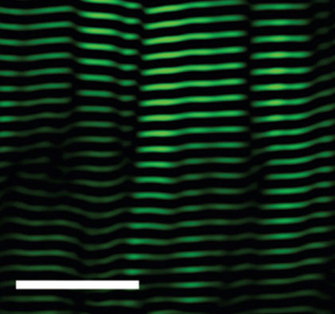
Effigy 1: A gastrocnemius muscle (calf) with striped blueprint of sarcomeres
The view of a mouse gastrocnemius (dogie) musculus nether a microscope. The sarcomeres are artifically colored green, and appear every bit stacked horzontal stripes of similar lengths. (White scale bar = 25 microns.)
© 2008 Nature Publishing Group Llewellyn, M. E. et al. Minimally invasive high-speed imaging of sarcomere contractile dynamics in mice and humans. Nature 454, 784-788 (2008). All rights reserved. 
The Sliding Filament Theory
In 1954, scientists published two groundbreaking papers describing the molecular basis of muscle wrinkle. These papers described the position of myosin and actin filaments at diverse stages of contraction in muscle fibers and proposed how this interaction produced contractile force. Using high-resolution microscopy, A. F. Huxley and R. Niedergerke (1954) and H. Due east. Huxley and J. Hanson (1954) observed changes in the sarcomeres every bit muscle tissue shortened. They observed that one zone of the repeated sarcomere arrangement, the "A ring," remained relatively constant in length during contraction (Effigy 2A). The A ring contains thick filaments of myosin, which suggested that the myosin filaments remained fundamental and constant in length while other regions of the sarcomere shortened. The investigators noted that the "I band," rich in thinner filaments made of actin, inverse its length along with the sarcomere. These observations led them to propose the sliding filament theory, which states that the sliding of actin past myosin generates muscle tension. Because actin is tethered to structures located at the lateral ends of each sarcomere called z discs or "z bands," whatever shortening of the actin filament length would result in a shortening of the sarcomere and thus the muscle. This theory has remained impressively intact (Figure 2B).
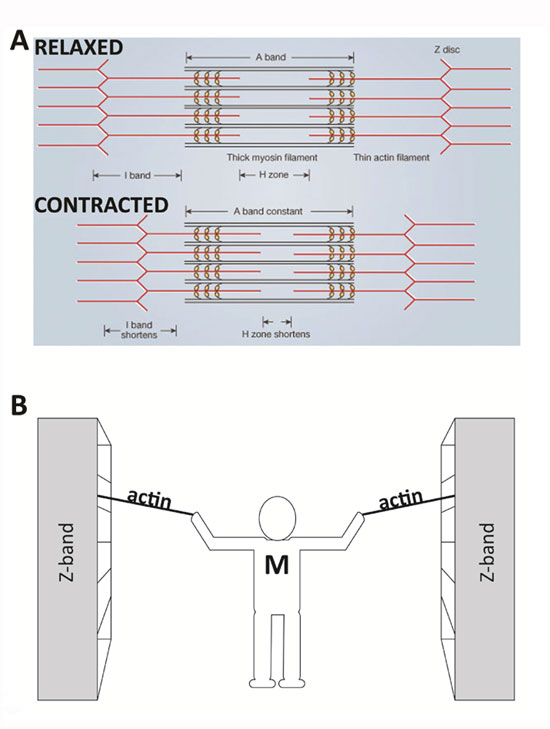
Figure 2: Comparison of a relaxed and contracted sarcomere
(A) The basic organisation of a sarcomere subregion, showing the centralized location of myosin (A band). Actin and the z discs are shown in scarlet. (B) A conceptual diagram representing the connectivity of molecules within a sarcomere. A person standing betwixt two bookcases (z bands) pulls them in via ropes (actin). Myosin (Thousand) is analogous to the person and the pulling arms. (z bands are also called z discs.)
© Nature Publishing Group A) adapted from Huxley, A. F. & Niedergerke, R. Structural Changes in Muscle During Wrinkle: Interference Microscopy of Living Muscle Fibres. Nature 172, 971-973 (1954). B) © Nature Education All rights reserved.
An Analogy for Sliding Filaments in a Sarcomere Shortening Event
Imagine that you are standing between two big bookcases loaded with books. These large bookcases are several meters apart and are positioned on track and then that they tin be easily moved. You are given the task of bringing the two bookcases together, just you are limited to using just your arms and 2 ropes. Continuing centered between the bookcases, you pull on the two ropes — one per arm — which are tied deeply to each bookcase. In a repetitive mode, you pull each rope toward you, regrasp it, and and so pull again. Eventually, every bit you lot progress through the length of rope, the bookcases motility together and approach you. In this example, your artillery are similar to the myosin molecules, the ropes are the actin filaments, and the bookcases are the z discs to which the actin is secured, which make upward the lateral ends of a sarcomere. Like to the manner you lot would remain centered between the bookcases, the myosin filaments remain centered during normal muscle wrinkle (Figure 2B).
What Are Cross Bridges, and How Do They Relate to Sliding Filaments?
One important refinement of the sliding filament theory involved the particular way in which myosin is able to pull upon actin to shorten the sarcomere. Scientists accept demonstrated that the globular terminate of each myosin protein that is nearest actin, chosen the S1 region, has multiple hinged segments, which can bend and facilitate contraction (Hynes et al. 1987; Spudich 2001). The bending of the myosin S1 region helps explicate the way that myosin moves or "walks" along actin. The slimmer and typically longer "tail" region of myosin (S2) also exhibits flexibility, and it rotates in concert with the S1 wrinkle (Figure 3A).
The movements of myosin appear to exist a kind of molecular trip the light fantastic toe. The myosin reaches forward, binds to actin, contracts, releases actin, and then reaches forwards again to bind actin in a new wheel. This procedure is known as myosin-actin cycling. As the myosin S1 segment binds and releases actin, it forms what are called cross bridges, which extend from the thick myosin filaments to the thin actin filaments. The contraction of myosin's S1 region is called the power stroke (Figure three). The power stroke requires the hydrolysis of ATP, which breaks a high-energy phosphate bond to release energy.
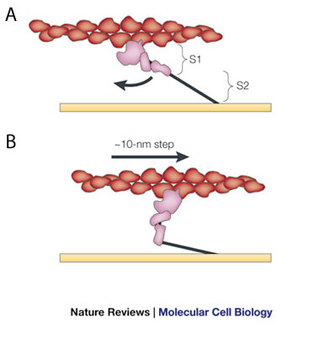
Effigy 3: The power stroke of the swinging cross-span model, via myosin-actin cycling
Actin (ruby-red) interacts with myosin, shown in globular class (pink) and a filament form (blackness line). The model shown is that of H. Eastward. Huxley, modified to point bending (curved pointer) most the middle of the elongated cantankerous bridge (subfragment 1, or S1) which provides the working stroke. This bending propels actin to the correct approximately 10 nanometers (x nm step). S2 tethers globular myosin to the thick filament (horizontal yellow line), which stays in place while the actin filament moves. Modified from Spudich (2001).
© 2001 Nature Publishing Group Spudich, J. A. The myosin swinging cantankerous-bridge model. Nature Reviews Molecular Jail cell Biology 2, 387-392 (2001). All rights reserved.
Specifically, this ATP hydrolysis provides the free energy for myosin to get through this cycling: to release actin, change its conformation, contract, and repeat the process again (Figure 4). Myosin would remain bound to actin indefinitely — causing the stiffness of rigor mortis — if new ATP molecules were not available (Lorand 1953).
Two key aspects of myosin-actin cycling utilise the free energy fabricated bachelor by the hydrolysis of ATP. Start, the action of the reaching myosin S1 head uses the free energy released after the ATP molecule is broken into ADP and phosphate. Myosin binds actin in this extended conformation. Second, the release of the phosphate empowers the contraction of the myosin S1 region (Effigy 4).
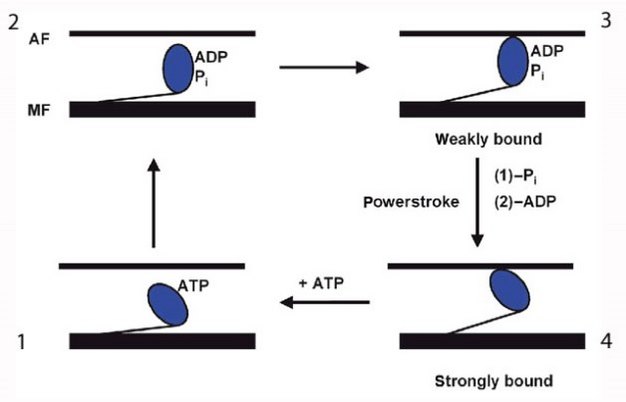
Figure iv: Illustration of the bicycle of changes in myosin shape during cross-bridge cycling (i, 2, 3, and 4)
ATP hydrolysis releases the energy required for myosin to do its job. AF: actin filament; MF myosin filament. Modified from Goody (2003).
© 2003 Nature Publishing Grouping Goody, R. S. The missing link in the musculus cross-bridge cycle. Nature Structural Biology x, 773-775 (2003). All rights reserved.
What Regulates Sarcomere Shortening?
Calcium and ATP are cofactors (nonprotein components of enzymes) required for the contraction of muscle cells. ATP supplies the energy, every bit described above, but what does calcium practise? Calcium is required by ii proteins, troponin and tropomyosin, that regulate muscle wrinkle past blocking the bounden of myosin to filamentous actin. In a resting sarcomere, tropomyosin blocks the bounden of myosin to actin. In the in a higher place analogy of pulling shelves, tropomyosin would get in the way of your hand as information technology tried to concord the actin rope. For myosin to bind actin, tropomyosin must rotate around the actin filaments to expose the myosin-binding sites. In 1994, William Lehman and his colleagues demonstrated how tropomyosin rotates by studying the shape of actin and myosin in either calcium-rich solutions or solutions containing low calcium (Lehman, Craig, & Vibertt 1994). By comparing the activity of troponin and tropomyosin under these two weather condition, they found that the presence of calcium is essential for the contraction machinery. Specifically, troponin (the smaller protein) shifts the position of tropomyosin and moves information technology away from the myosin-bounden sites on actin, effectively unblocking the bounden site (Figure 5). In one case the myosin-binding sites are exposed, and if sufficient ATP is present, myosin binds to actin to begin cross-span cycling. And so the sarcomere shortens and the muscle contracts. In the absenteeism of calcium, this binding does not occur, then the presence of complimentary calcium is an important regulator of muscle wrinkle.
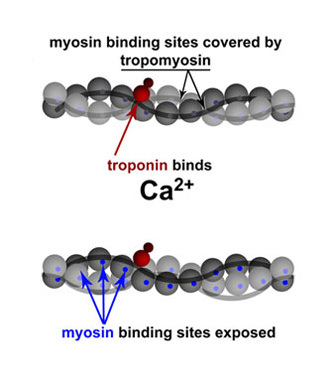
Figure five: Troponin and tropomyosin regulate contraction via calcium binding
Simplified schematic of actin backbones, shown as grey chains of actin molecules (balls), covered with smooth tropomyosin filaments. Troponin is shown in ruddy (subunits not distinguished). Upon binding calcium, troponin moves tropomyosin away from the myosin-binding sites on actin (bottom), effectively unblocking it. Modified from Lehman et al. (1994).
© 1994 Nature Publishing Group Lehman, W., Craig, R. & Vibert, P. Caii+-induced tropomyosin motion in Limulus sparse filaments revealed past three-dimensional reconstruction. Nature 368, 65-67 (1994). All rights reserved.
Unresolved Questions
Is muscle contraction completely understood? Scientists are still curious nearly several proteins that clearly influence muscle contraction, and these proteins are interesting because they are well conserved across beast species. For example, molecules such as titin, an unusually long and "springy" poly peptide spanning sarcomeres in vertebrates, appears to bind to actin, but information technology is not well understood. In addition, scientists take made many observations of muscle cells that acquit in means that do not match our current understanding of them. For example, some muscles in mollusks and arthropods generate force for long periods, a poorly understood phenomenon sometimes called "catch-tension" or force hysteresis (Hoyle 1969). Studying these and other examples of musculus changes (plasticity) are heady avenues for biologists to explore. Ultimately, this inquiry can help u.s.a. better understand and treat neuromuscular systems and better empathize the diversity of this mechanism in our natural world.
Summary
Muscle contraction provides animals with great flexibility, assuasive them to move in exquisite ways. The molecular changes that result in muscle wrinkle have been conserved across evolution in the majority of animals. By studying sarcomeres, the basic unit controlling changes in muscle length, scientists proposed the sliding filament theory to explicate the molecular mechanisms behind muscle contraction. Inside the sarcomere, myosin slides along actin to contract the muscle fiber in a process that requires ATP. Scientists have besides identified many of the molecules involved in regulating musculus contractions and motor behaviors, including calcium, troponin, and tropomyosin. This inquiry helped us learn how muscles can change their shapes to produce movements.
References and Recommended Reading
Clark, M. Milestone 3 (1954): Sliding filament model for muscle wrinkle. Muscle sliding filaments. Nature Reviews Molecular Cell Biology 9, s6–s7 (2008) doi:x.1038/nrm2581.
Goody, R. South. The missing link in the muscle cross-bridge cycle. Nature Structural Molecular Biology 10, 773–775 (2003) doi:10.1038/nsb1003-773.
Hoyle, G. Comparative aspects of muscle. Almanac Review of Physiology 31, 43–82 (1969) doi:10.1146/annurev.ph.31.030169.000355.
Huxley, H. East. & Hanson, J. Changes in the cantankerous-striations of musculus during contraction and stretch and their structural interpretation. Nature 173, 973–976 (1954) doi:ten.1038/173973a0.
Huxley, A. F. & Niedergerke, R. Structural changes in muscle during contraction: Interference microscopy of living muscle fibres. Nature 173, 971–973 (1954) doi:10.1038/173971a0.
Hynes, T. R. et al. Movement of myosin fragments in vitro: Domains involved in forcefulness product. Cell 48, 953–963 (1987) Doi:10.1016/0092-8674(87)90704-5.
Lehman, W., Craig, R. & Vibertt, P. Ca2+-induced tropomyosin movement in Limulus thin filaments revealed past three-dimensional reconstruction. Nature 368, 65–67 (1994) doi:10.1038/368065a0.
Lorand, L. "Adenosine triphosphate-creatine transphosphorylase" as relaxing gene of muscle. Nature 172, 1181–1183 (1953) doi:10.1038/1721181a0.
Spudich, J. A. The myosin swinging cross-bridge model. Nature Reviews Molecular Cell Biology ii, 387–392 (2001) doi:10.1038/35073086.
Source: https://www.nature.com/scitable/topicpage/the-sliding-filament-theory-of-muscle-contraction-14567666/
Posted by: hardinander1983.blogspot.com
0 Response to "How Is Muscle Arranged For Fast Animals"
Post a Comment