

Why Is More Known About Animals With Hard Parts Than Is Known About Animals With Soft Parts?

Soft-bodied organisms are animals that lack skeletons. The group roughly corresponds to the grouping Vermes as proposed by Carl von Linné. All animals take muscles but, since muscles can only pull, never push, a number of animals have developed hard parts that the muscles can pull on, commonly called skeletons.[1] Such skeletons may be internal, as in vertebrates, or external, equally in arthropods. However, many animals groups do very well without hard parts.[ii] This include animals such equally earthworms, jellyfish, tapeworms, squids and an enormous multifariousness of animals from almost every part of the kingdom Animalia.
Commonality [edit]
Most soft-bodied animals are small, but they do make up the bulk of the animal biomass. If we were to weigh up all animals on Globe with hard parts against soft-bodied ones, estimates point that the biomass of soft-bodied animals would exist at to the lowest degree twice that of animals with hard parts, quite possibly much larger.[3] Particularly the roundworms are extremely numerous. The nematodologist Nathan Cobb described the ubiquitous presence of nematodes on Earth as follows:
"In brusque, if all the matter in the universe except the nematodes were swept away, our world would still exist dimly recognizable, and if, as disembodied spirits, nosotros could then investigate it, we should find its mountains, hills, vales, rivers, lakes, and oceans represented by a picture of nematodes. The location of towns would be decipherable, since for every massing of homo beings there would exist a corresponding massing of certain nematodes. Copse would still stand up in ghostly rows representing our streets and highways. The location of the various plants and animals would still be decipherable, and, had nosotros sufficient knowledge, in many cases even their species could exist determined by an exam of their erstwhile nematode parasites."[4]
Beefcake [edit]
Not being a true phylogenetic grouping, soft-bodied organisms vary enormously in anatomy. Cnidarians and flatworms have a single opening to the gut and a lengthened nerve system. The roundworms, annelids, molluscs, the various lophoporate phyla and non-vertebrate chordates have a tubular gut open at both ends. While the majority of the soft-bodied animals typically don't have any kind of skeleton, some exercise, mainly in the form of potent cuticles (roundworms, h2o bears) or hydrostatic skeletons (annelids).[5]
While lack of a skeleton typically restricts the trunk size of soft-bodied animals on state, marine representatives tin grow to very large sizes. The heaviest soft-bodied organisms are likely the giant squids, with maximum weight estimated at 275 kilograms (606 lb) for females, while arctic lion's mane jellyfish may reach comparable sizes.[half-dozen] [7] The longest animal on record is also thought to be a soft-bodied organism, a 55 metres (180 ft) long thread-like bootlace worm, Lineus longissimus found on a Scottish beach 1864.[eight] Siphonophores may grow to considerable sizes too, though they are colonial organisms, and each single brute is small.[9] Virtually soft-bodied organisms are every bit small or smaller, even microscopic. The various organisms grouped equally mesozoans and the curious Placozoa are typically composed of just a few hundred cells.[2]
Fossil record [edit]

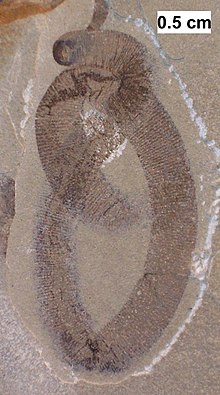
Like the Burgess Shale, the Waukesha Biota, from the Silurian of Wisconsin, preserves many soft-bodied organisms, such as this possible leech.

Examples of gaps within the fossil record of delicate and soft-bodied animals display numerous discontinuities of 150 Myr and more
The lack of hard parts in soft-bodied organisms makes them extremely rare in the fossil record. Appropriately, the evolutionary histories of many of the soft-bodied groups are poorly known. The showtime major detect of fossil soft-bodied animals was from the Burgess Shale in Canada.[ten] Today, several sites with Burgess Shale blazon preservation are known, but the history of many groups of soft-bodied animals is still poorly understood.
References [edit]
- ^ Marieb, Elaine; Hoehn, Katja (2007). Human Anatomy & Physiology (7th ed.). Pearson Benjamin Cummings.
- ^ a b Ruppert, E. E.; Fob, R. S.; Barnes, R. D. (2004) Invertebrate Zoology (seventh ed.). Brooks / Cole. ISBN 0-03-025982-7
- ^ Greenstreet, South.; Robinson, L.; Reiss, H.; Craeymeersch, J.; Callaway, R.; Goffin, A.; Jørgensen, L.; Robertson, M.; Kröncke, I.; de Boois, I.; Jacob, N.; Lancaster, J. (2007) Species composition, diversity, biomass and production of the benthic invertebrate community of the Due north Ocean Fisheries Research Services Collaborative Report No 10 (2007): 67 pp.
- ^ Cobb, N. A. (1914). Nematodes and their relationships. Yearbook, United states Department of Agronomics. pp. 457-490 (esp. p. 472). [ permanent expressionless link ]
- ^ Ruppert, Edward Eastward.; Barnes, Robert D. (1991). Invertebrate Zoology (sixth ed.). Fort Worth: Saunders College Publ. [u.a.] ISBN978-0030266683.
- ^ O'Shea, S. (2003) Giant Squid and Colossal Squid Fact Canvass The Octopus News Mag Online.
- ^ "Lion's Mane Jellyfish - Reference Library". redOrbit . Retrieved September iii, 2010.
- ^ Carwardine, Mark (1995) The Guinness Book of Animal Records. Guinness Publishing. p. 232.
- ^ Dunn, Casey (2005) Siphonophores. Retrieved July 8, 2008.
- ^ Clarkson, E. N. K. (1993) Invertebrate Palaeontology and Evolution (third ed.). Chapman & Hall, ISBN 0-412-47990-7
Source: https://en.wikipedia.org/wiki/Soft-bodied_organism
Posted by: hardinander1983.blogspot.com
0 Response to "Why Is More Known About Animals With Hard Parts Than Is Known About Animals With Soft Parts?"
Post a Comment